

70% of Brokers & Advisors Say Most Clients Face Double-Digit Renewal Increases
Insights from The Phia Group’s 2026 Broker Survey
New Analysis Finds Providers Seek 3–5x More Than Health Plans Offer – and Continue to Win More Than 80% of Federal Arbitration Cases
August 4, 2026
By: David Ostrowsky
At first blush, America’s now decadeslong healthcare affordability crisis stems from such well-known culprits as inflated prescription drug prices, rampant administrative waste, and escalating deductibles and premiums. While these are all contributing factors, a more nuanced assessment of the underlying dynamics suggests that one unintended consequence of the No Surprises Act (NSA) is sneakily helping to drive healthcare costs skyward.
Earlier this decade, Congress passed the NSA primarily to safeguard patients against surprise balance bills triggered by emergency services rendered via out-of-network providers and facilities. But the other core feature of the legislation—establishing an equitable system for resolving payment squabbles between physicians and insurance companies—has proven to be an abject disappointment, essentially undermining the NSA’s initial overarching mission to contain healthcare costs. Undoubtedly, the federal Independent Dispute Resolution (IDR) system, ostensibly created to resolve disputes between parties in an impartial manner, has consistently yielded results heavily tilted towards providers, both in terms of how frequently they prevail and the extent to which they do so.
And The Phia Group, as one of America’s preeminent healthcare cost containment companies, has the cold hard facts to prove it.
On July 21, The Phia Group unveiled its very own data analysis, grounded in an exhaustive examination of the Centers for Medicare & Medicaid Services (CMS) Federal IDR public-use files from 2023 through the first half of 2025, indicating that providers routinely pursue reimbursement amounts three to five times higher than health plan payment offers. And that’s only on average. There are some specialty areas, such as neuromonitoring and radiology, in particular, along with pathology and diagnostic imaging, in which provider demands surpassed plan offers tenfold, twentyfold, and even thirtyfold.
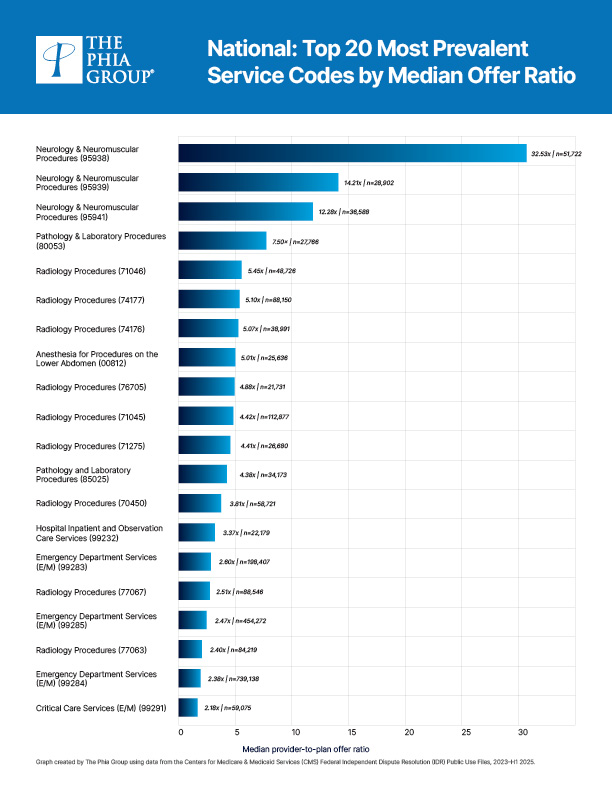
Interestingly, this situation is not isolated to any one region of the country, as across most states, providers are seeking between three and five times what health plans offer for a particular service. In other words, the gaping differences are fueled, if anything, by the type of service at stake, not where the billing dispute is occurring. Perhaps this situation should not come as a surprise, given that the exceptionally high volume of disputes flooding the federal IDR system, one that is largely bereft of transparency, has overwhelmed certified IDR entities. Nevertheless, The Phia Group’s analysis has provided irrefutable evidence that some providers have gamed the system by developing a reliably effective reimbursement methodology yielding self-serving outcomes: In fact, Phia’s data indicates that provider success rates hover above 80% across essentially all offer-ratio categories, including disputes in which providers sought payments more than ten times greater than plan offers.
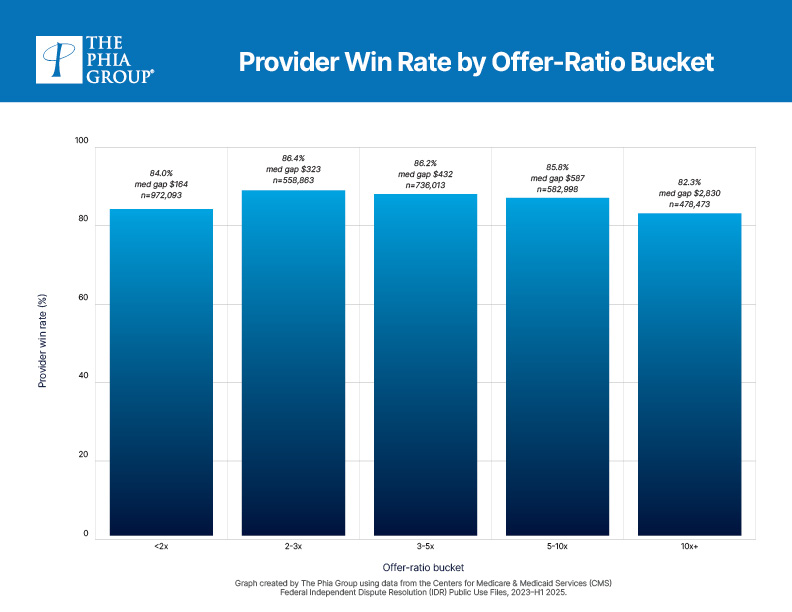
But what, exactly, is the correlation between a select group of providers seeking (and often being awarded) exorbitantly high reimbursement amounts and healthcare affordability for the masses? When providers and health plans frequently engage in arbitration with drastically different reimbursement standards—and the former repeatedly prevails by a large margin—the subsequent reimbursement amounts can significantly elevate costs for self-funded employers and, by extension, their respective employees and families. Simply put, if insurers constantly have to go through the hassle of the IDR process while not getting properly reimbursed, they will have to compensate by hiking up premiums, co-pays, co-insurance, and deductibles for plan participants.
“The high volume of IDR disputes is generating significant spending from administrative costs and higher payments for services,” researchers from Georgetown University wrote in their study that was published in Health Affairs last year. “This higher spending will likely be reflected in higher overall health costs and consumer premiums in the future.”
Unfortunately, a snapshot of recent data suggests this trend is only getting exacerbated. This July, newly released data from the Centers for Medicare & Medicaid Services indicated that approximately 1.4 million disputes were initiated in the latter half of 2025—a sharp increase from the nearly 1.2 million disputes initiated in the first six months of the year. Meanwhile, The Wall Street Journal recently reported that providers earned nearly $15 billion in IDR payouts last year—a precipitous increase from the nearly $4.1 billion in payments made in 2024.
“Outrageous provider-driven abuse of the No Surprises Act is adding billions in wasteful spending and raising healthcare costs for everyone,” Chris Bond of AHIP (the national trade association representing the health insurance industry) said in response to the aforementioned CMS reports. “Policy action is needed to address flawed incentives in the IDR process, put an end to this gold rush and protect consumers from unconscionable price gouging by some out-of-network providers and IDR middlemen.”
Indeed, for the financial well-being of employer-sponsored health plans and their respective participants, the role the federal IDR process is playing in healthcare reimbursement negotiations cannot be ignored.